
Elisabeth,52
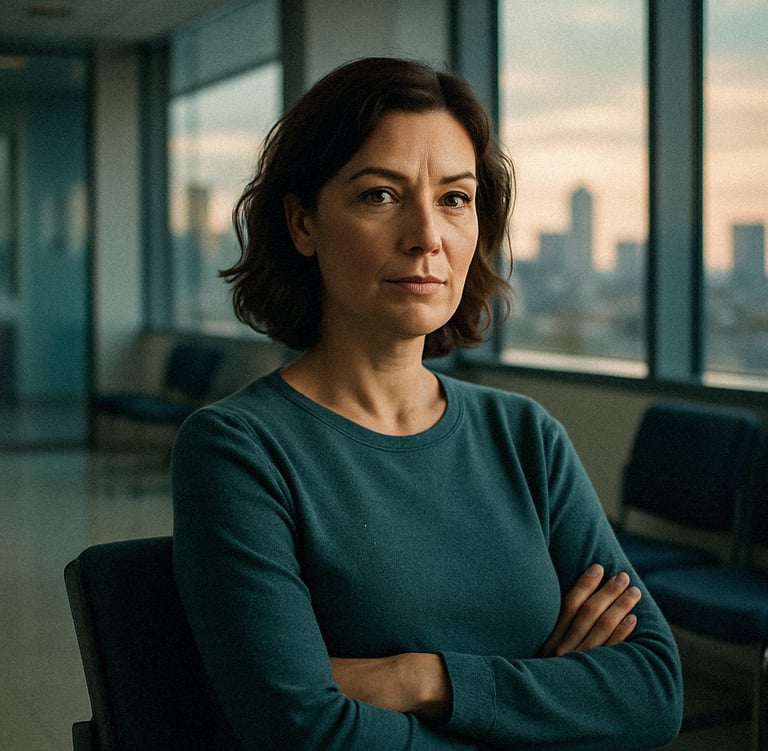
Elisabeth waits patiently in yet another clinic, where the soft hum of routine offers comfort—and something more. What brings her back again and again remains known only to her.
3 min read
The Patient's Secret:
Twice a month, always on a Tuesday, Elisabeth Bruckner boards a regional train headed nowhere in particular — just somewhere with a hospital and a clipboard. She arrives 47 minutes early, always. Not to prepare. To marinate.
She doesn’t bring a handbag. Just a pale blue folder marked “Medical Records” in quiet, sensible font. Inside: copies of old intake forms, test results with someone else’s date of birth she’s adopted as her own, and a neatly folded page of rehearsed symptoms. She rotates them. Fatigue. Numbness. “Temporal dislocation.”
Her secret isn’t the symptoms. It’s the fact that none of them are real.
Elisabeth is 52, or says she is. Sometimes she’s 49, if that better fits the eligibility criteria. She fabricates just enough. “Functional pain with unclear etiology.” It’s hard to prove what you can’t see. She’s clever like that.
She knows which clinics don’t ask too many questions, which GPs are overstretched and inattentive. She knows which psychology trials accept self-referrals, which university research groups advertise in the free weekly paper, looking for participants with vague dissatisfaction. She keeps a spreadsheet. Color-coded tabs for mood disorders, gastrointestinal anomalies, and rare sensory conditions. A whole interior life, neatly categorized.
She doesn’t do it for money. The stipends are minor. Enough to cover train fare and the cheap coffee she sips while listening to strangers describe her body like it’s a specimen in a museum. No, it’s not the cash. It’s the ritual.
The sterile interview rooms. The pulse oximeter clipped to her finger like a lie detector. The small, devout attention of someone writing down her words. The act of being observed. Studied. Measured.
Sometimes, they ask how long she’s been feeling “this way.” She smiles softly, eyes dropping to the floor like she’s ashamed to remember. “A while now,” she says. “But I didn’t want to bother anyone.” Doctors love that line. Interns especially. It makes them feel like rescuers.
At home, in a small town where the trains don’t even announce the stops anymore, Elisabeth has turned her cellar into a museum of her fictional ailments. A hundred pill bottles, many unopened. Brochures for conditions she does not have. A white lab coat from a workshop she once crashed and walked out with. Her ex-husband’s old coat hangs beside it — threadbare and smelling faintly of bitter herbs and a man who took all the attention with him when he left.
Her adult children send her links. “How are you, Mom?” always followed by some digital version of not being there. They think she’s fragile. That she needs time. But Elisabeth doesn’t want time. She wants intake. Last spring, she nearly got caught.
She had been participating in a psych study in one town — a group therapy model for “existential dislocation.” (She liked that one. It had incense.) And two weeks later, she enrolled in a pharmacological trial in the next town over. Different diagnosis. Different age. Different name. But during the second session, a research assistant lingered too long on her form. His brow folded. “Have you done a study like this before?” he asked, slowly. Elisabeth smiled and tilted her head. “Not like this,” she said. The moment passed. He nodded, made a note, moved on.
But Elisabeth felt it. The buzz. The dizzy, terrible delight of almost. It stayed with her for days. She couldn’t eat. She rehearsed answers for questions no one had asked. She felt radiant. Charged.
Since then, she’s gotten sloppier. More bold. Once she gave two different names in the same month at the same hospital. No one noticed. Or maybe they did and just let her play. Sometimes, she wonders if they’re watching her too — as a kind of long game. A meta-study. A patient who only exists in examination.
The lie isn’t the point anymore. It’s the audience. The moment someone pulls their chair close, leans in with a pen, and says, “Tell me more.” It’s the only place where she feels shaped. Tangible. Necessary.
One night, alone in her apartment, Elisabeth opens a drawer filled with her old medical bracelets. Plastic, color-coded, each one a tiny trophy. She runs her fingers over the names — Frau K., Elise Moreau, B. Thielmann. She reads them aloud. Her forgotten selves. Her private sorority of need. She tells herself she’ll stop. That the next study will be the last. But she already knows which trial she’ll apply to next — something about circadian rhythm disorders. She’s practicing insomnia. Getting good at it. She dreams of someday being caught, properly. Investigated. Written about. A case study of her own. Until then, she continues. Early train. Blue folder. Tired smile. Another Tuesday.
Because someone has to be sick. And Elisabeth has never been good at being nobody.